Watch Live
The Leader
Guiding Principles
Every policy decision evaluated through the lens of social justice — does it benefit the marginalised, the poor, the working class and the historically disadvantaged communities of Tamil Nadu?
Vijay has declared a strict zero-tolerance policy on corruption in governance. Whistleblower protection, transparent G.O. issuance, and public audit of all major contracts.
Women welfare is at the centre of TVK governance. Free bus, monthly aid, safety, healthcare, education and economic independence form the women's welfare pillar.
Economic growth that protects Tamil Nadu's environment, farmers' land rights and traditional livelihoods. No industrial development at the cost of ecology or farming communities.
Tamil Nadu must control its own education. NEET must be abolished. State-controlled admissions must return. The best doctors should come from Tamil Nadu's best students.
Tamil Nadu's rights under the federal structure must be protected and expanded. Water disputes, education rights, GST share — all to be fought for Tamil Nadu's interests.
Promises vs Reality
Governance Actions
G.O. issued extending the existing free bus travel scheme for women. Rollout is ongoing — coverage currently varies by route and depot, with TNSTC and MTC (Chennai) services included; full coverage across all routes is still in progress.
Minimum Support Price revised upward for paddy, mango and other key crops. Benefit reaching farmers in 38 districts. Announced in first cabinet meeting.
One free LPG cylinder per month for BPL/PDS women-headed households was a TVK manifesto promise. Not yet implemented — formal allocation is pending the first Budget session, expected July 2026.
Government order issued for complete audit of all ~5,400 TASMAC outlets. 3-month timeline. First step toward TASMAC reform as promised in manifesto.
Formal petition filed in Supreme Court for restoring Education to the State List and ending NEET in Tamil Nadu. Senior advocates engaged. Case being pursued urgently.
First batch of 40,000 posts from 1.2 lakh vacant government positions being filled via TNPSC. Notifications issued. Process underway across departments.
Monthly financial assistance scheme for women from economically weaker sections. Budget allocation being finalised. Expected rollout in second quarter of governance.
Full public report on 100 days of TVK governance — transparent accountability on every promise. To be published and shared across Tamil Nadu on completion of 100 days in office.
Fort St. George
Petitions to the CM can be submitted every Monday at District Collectors' offices OR online at the CM grievance portal on tn.gov.in.
Financial assistance for medical treatment, natural disasters and other emergencies. Apply through District Collector or online portal.
Call 1100 (CM Helpline) for any governance complaint. Available 24/7. Complaints are registered and forwarded to respective departments.
1952 — 2026
Tamil Nadu (previously Madras State) has had 9 Chief Ministers since 1952. Here is the complete history — their tenures, achievements, legacies and what they left behind for Tamil Nadu.
The first Chief Minister of Madras State, P. S. Kumaraswamy Raja served briefly in 1952. A senior Congress leader, he laid the groundwork for the early democratic administration of the newly formed state before being succeeded by Rajagopalachari.
Chakravarti Rajagopalachari, popularly known as Rajaji, was a lawyer, independence activist and close associate of Gandhi. As Chief Minister he shaped the early governance framework of Madras State. His educational policy ('Kula Kalvi Thittam') remains debated to this day.
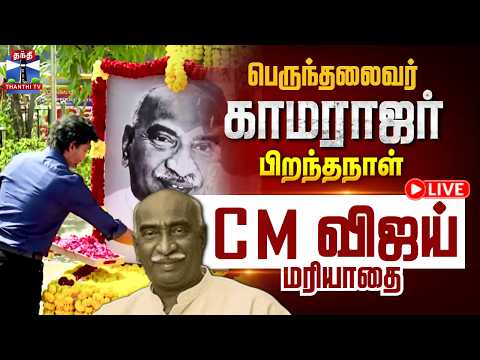
Kumaraswami Kamaraj is remembered as the 'King Maker' of Indian politics. He served as CM for nine transformative years — expanding schools, building roads and electrifying villages. He sacrificed his CM post through the 'Kamaraj Plan' to serve the national party. Longest-serving CM of the Congress era.
Miniambalam Bhakthavatsalam was the last Congress Chief Minister of Tamil Nadu. His government was defeated in 1967 by the DMK — ending 15 years of Congress rule. The defeat began a new political era in Tamil Nadu.
Conjeevaram Natarajan Annadurai, affectionately called 'Anna' (Elder Brother), founded the DMK and became Tamil Nadu's first non-Congress CM. He renamed Madras State as Tamil Nadu in 1969. He passed away in office — mourned by millions. A transformative figure in Tamil political history.
Vengalil Ramamurthy Nedunchezhiyan served as Acting Chief Minister briefly after the passing of Annadurai in February 1969, before Karunanidhi was sworn in. He was a trusted DMK leader and served as minister in multiple cabinets over several decades.
Muthuvel Karunanidhi — known as Kalaignar — was the longest-serving Chief Minister of Tamil Nadu with approximately 19 years across four separate terms (1969–76, 1989–91, 1996–2001, 2006–11). A prolific Tamil writer, playwright and politician, he led DMK for over five decades until his passing in 2018.
Marudur Gopalan Ramachandran — MGR — was a beloved film actor who founded AIADMK and became one of Tamil Nadu's most popular CMs. He served for a decade and introduced the Noon Meal Scheme, a landmark welfare programme that fed millions of school children. He passed away in office in 1987.
Videkar Nageswari Janaki Ramachandran, widow of MGR, was sworn in as Chief Minister briefly in January 1988 after MGR's passing. Her government fell within weeks due to a floor test failure. She is one of the few women to have held the CM post in Tamil Nadu.
Jayaram Jayalalithaa — Amma — was AIADMK's iconic leader who served as CM across multiple terms (1991–96, 2001–06, 2011–16). One of Tamil Nadu's most powerful and influential CMs, she is remembered for welfare schemes including free colour TVs, mixers, grinders, fans and the Amma Canteen. She passed away in office in December 2016.
Ottakarathevar Panneerselvam served as caretaker CM three times — whenever Jayalalithaa stepped aside (once due to her conviction, twice after her passing). A loyalist figure within AIADMK, he later led a faction that split from the party. He supported the TVK government in the 2026 confidence vote.
Edappadi K. Palaniswami became Chief Minister in February 2017 after a period of political uncertainty within AIADMK following Jayalalithaa's passing. He served a full term until 2021 when DMK won the election. He led the opposition after 2021 and again in 2026 — but AIADMK fell to 47 seats as TVK swept 108.
Muthuvel Karunanidhi Stalin, son of Kalaignar, led DMK to a decisive victory in 2021 and served as CM for five years. His government focused on industrialisation, welfare and Tamil identity. In 2026 he ran for re-election but DMK finished second with 59 seats as TVK emerged as the new dominant force.
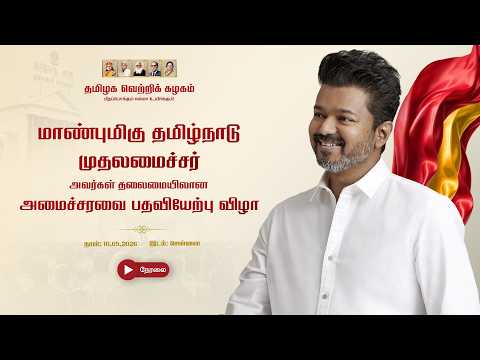
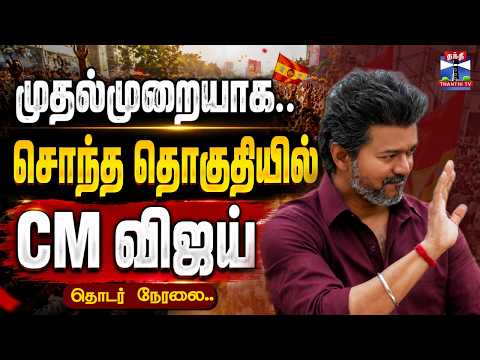
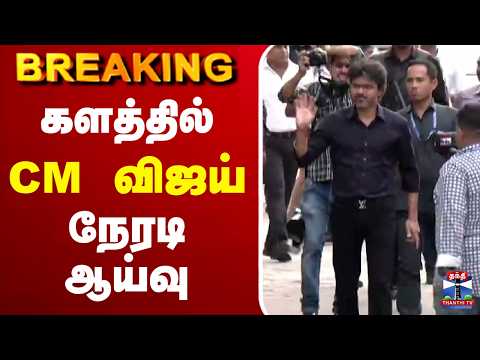
C. Joseph Vijay — Thalapathy — founded TVK on 2 February 2024 and led it to a historic 108-seat victory in its very first election on 23 April 2026. Sworn in as the 13th Chief Minister on 10 May 2026, he broke the 60-year DMK–AIADMK alternation. His cabinet includes 35 ministers from TVK, Congress, VCK and IUML.
Every chapter of his journey from cinema to Chief Minister